








Confirming atmospheric processes and structures as predicted by own forecasts using soaring flights

Main objective of Organisation Scientifique et Technique Internationale du Vol à Voile (OSTIV) is the promotion and coordination on an international level of sciences and technologies related to soaring flight, in particular the use and operation of sailplanes in research. OSTIV is a member of the Federation Aeronautique Internationale ( FAI ) and considers itself an innovative force in promoting air sports
The Mountain Wave Project (MWP) - a project of the scientific and meteorological panel of OSTIV, was conceived during an OSTIV seminar 1998 in Serres/France by René Heise and Klaus Ohlmann and is temporally supported by several enthusiastic scientists/pilots since.

Joachim Kuettner, Atmospheric Researcher
"...curiosity and joy of adventure.
If you can preserve these two wonderful afflictions through your life, you will never be able to stop exploring the atmosphere." born 1909 and still exploring
Ulf Merbold, Astronaut, January 2003
" Turbulence in rotor systems - like riding a mustang in a rodeo..."

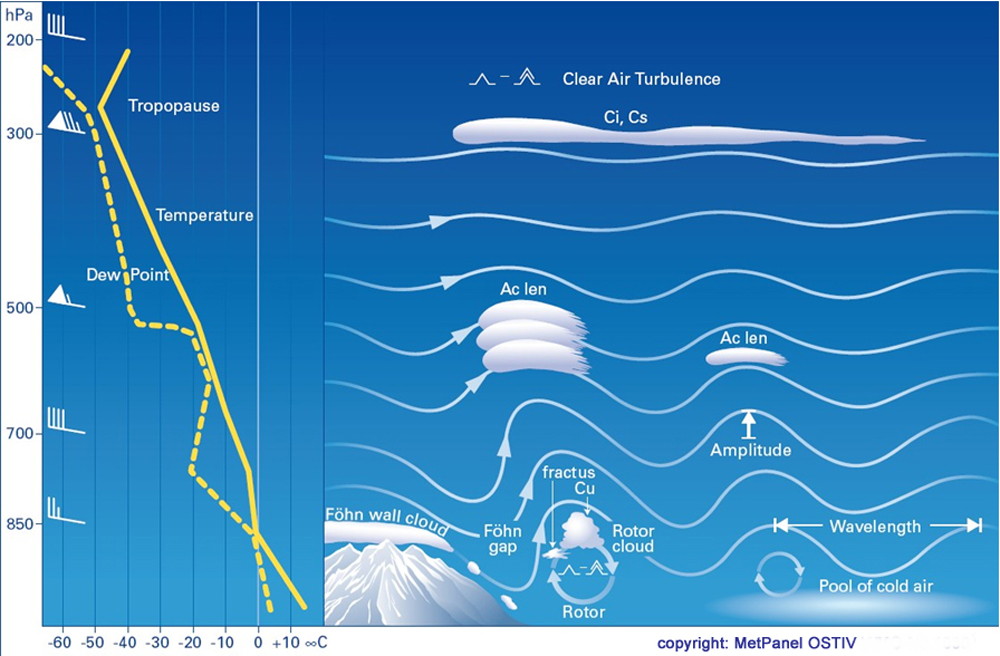
Focal point of the ongoing and planned activities of the meteorologcal section is the Mountain Wave Project (MWP). Its ambitious goal is the global classification and analysis of mountain waves and their associated rotor bands
Results and know-how gained from these studies are not only being applied to the planning and execution of record flights, but also incorporated into methods and procedures of general aviation weather briefings as well as into the relevant stages of pilot training.
- Detection and determination of physical processes in the atmosphere, as well as their associated synoptic characteristics, which play a dominant role in the generation and development of mountain waves
- Investigation of rotor bands, determination of their location, spatial extension and classification of concomitant turbulence
- High resolution measurement of relevant meteorological variables (eg, potential temperature, turbulence parameters, vertical and horizontal wind, humidity...)
- Visualisation of the regions of turbulence (system Rotor-Wave) in a Geographical Information System (GIS)
- Development of forecast tools in connection with weather models. Verification of mesoscale forecast models and adjustment of the applied parametrisations
- Application of the acquired data and scientific results to pilot training, in particular to the design of training missions and simulator sessions, as well as, to air traffic route planning
A major effort towards the goal of a global classification of mountain waves has been launched in October í99, when a highly competent team of experienced mountain pilots and scientists collected data on the wave systems in the Andes. San Martin de los Andes in Argentina was chosen to be base camp for the flying operations. In addition to several transsections flown in the wave systems, a number of successful world record attempts has been completed. The most spectacular results of the MWP activities was achieved a year later, when K. Ohlmann set a world distance record of 2.464km in the lee of the Andes. He had extend this world-record on january 2003 with an incredible distance of 3.008,8 k. See also last world record 2010...

FAI WR Free Distance 12/01/2010
OSTIV-Award: " 2.000km Dr. Joachim Kuettner Prize "
 Second Awardee of "Lilienthal- Prize "
 European Meteorological Society - Media Award 2011
May 2011 - Finalist of the SPACE MEDICINE ASSOCIATION JEFF
MYERS YOUNG INVESTIGATOR AWARD (AsMA-News 2011; p. 853)
List of publications
Heise, R. (2017): Birds, Gliders and Uplift Systems over the Himalayas. In H. Prins & T. Namgail (Eds.), Bird Migration across the Himalayas: Wetland Functioning amidst Mountains and Glaciers (pp. 219-228). Cambridge: Cambridge University Press. doi:10.1017/9781316335420.018
Ohlmann, K. (2017): The Wind System in the Himalayas: From a Bird’s-Eye View In H. Prins & T. Namgail (Eds.), Bird Migration across the Himalayas: Wetland Functioning amidst Mountains and Glaciers (pp. 217-218). Cambridge: Cambridge University Press. doi:10.1017/9781316335420.017
Ledderhos, C.; Heise, R.; Gammel, C.;Gens, A. (2015): Inflight measurements of oxygen saturation during MOUNTAIN WAVE PROJECT (MWP) high altitude glider flights in the Himalaya region and the French Alps; Wehrmedizinische Monatsschrift 59, 9-10, p.286-292, ISSN 0043-2156
Gens, A.; Heise, R.; Gammel, C.; Ledderhos, C. (2014): In-flight measurements of oxygen saturation at altitude flights within the scope of the Mountain Wave Projects in the Himalayas and the French Alps. Methodological aspects; 52nd Annual Conference, German Society of Aviation and Space Medicine (DGRLM); Poster
Heise, R., Etling, D. (2014): Gravity waves and rotors, promet, 39, 1/2, pp. 36-44; ISSN 0340-4552
Heise, R.; Brauchle, J.; Dahmann, P.; Junkermann, W.; Ledderhos, C. (2014): The MWP-Himalaya research expedition- challenges, objectives and the first scientific results of this outstanding airborne measurement campaign in Nepal, Abstract, XXXII. OSTIV Congress Leszno 2014, p.26-28; ISBN-13: 978-6054303359; ( Abstract- PDF )
Heise, R. (2011) : Understanding Mountain Gravity Waves Helps Optimize Glider Flights over the Andes, ArcNews-Magazine, p.32, online-version
Heise, R. (2011) : Meteorological Calender 2011 ( back side Oct ), European Meteorological Society
Ultsch, A, Heise, R. (2010) : Data Mining to Distinguish Wave from Thermal Climbs in Flight Data, to appear in Advances in Data Analysis, Data Handling and Business Intelligence (Proc. of the 34nd Annual Conference of the Gesellschaft für Klassifikation e.V., July 21-23, 2010, Karlsruhe), Springer Verlag
Heise, R. (2010): Wellenaufwinde in Atmosphärenphysik und Extremsport, arcAktuell, 3/2010, S.14 ( online-article )
Knueppel, J. , Heise,R. (2010): Aviation Medicine - MWP Mendoza 2006, Aerospace Medical Association Meeting Phoenix (AZ), Poster
MetPanel OSTIV (2009): Weather Forecasting for Soaring Flight, World Meteorological Organisation (WMO), No. 1038, 76 p. ( Info - Contents )
Heise, R., Herold, W-D. (2008) : Meteorological Calender 2008 (back side Febr), European Meteorological Society ( PDF-File )
Hacker, J. et.al. (2007): Measuring mountain waves and turbulence at up 12km altitude over the Andes in South America using an instrumented motorised glider, 14th National Australian Meteorological and Oceanographic Society (AMOS) Conference in ADELAIDE (AUSTRALIA), ( PDF-File )
Doernbrack, A., Heise, R. , Kuettner, J. (2006): Wave and Rotors, promet, 32, 1-2, p. 18-24
Lindemann, C., Heise, R. , Herold, W-D.(2001): Leewaves in the Andes Region, Mountain Wave Project (MWP) of OSTIV, submitted to XXVII. OSTIV Congress, Mafikeng, South Africa, TECHNICAL SOARING, Vol. 32, number 3, ( TS-article )
Heise, R. (2001): Orografische Turbulenz als Forschungsobjekt und sportliche Herausforderung, Mitteilungen der Deutschen Meteorologischen Gesellschaft, 3, p. 13-25 ( online- article )
Knueppel, J. (2000): Gliding Aviation Medicine, High Altitude Aspects and Mountain Wave Project 1999, St. Martin de los Andes, Argentina, Poster, Jahrestagung der Deutschen Gesellschaft für Luft- und Raumfahrtmedizin, Berlin, ( online-article )
Selection of lectures
Ledderhos, C.; Heise, R.; Gammel, C.; Gens, A. (2017): FIELD PHYSIOLOGY: Inflight Measurements to monitor oxygen saturations of pilots during high-altitude glider flights of the Mountain Wave Project in the Himlayan region and the French Alps, XXXIII. OSTIV Congress, Benalla (AUS), 2017, OSTIV-Book abstract
Ohlmann, K. (2015): Mountain Wave Project Himalaya - Fasten your seat belts; Luftfahrt der Zukunft, Haus der Wissenschaft Braunschweig,
Ledderhos, C; Heise, R; Gammel, C.; Gens. A (2014): In-flight measurements of oxygen saturation at altitude flights within the scope of the Moutain Wave Projects in the Himalayas and the French Alps. Results; 52nd Annual Conference, German Society of Aviation and Space Medicine (DGRLM)
Heise, R.; Brauchle, J.; Dahmann, P.; Junkermann, W.; Ledderhos, C. (2014): The MWP-Himalaya research expedition- challenges, objectives and the first scientific results of this outstanding airborne measurement campaign in Nepal, XXXII. OSTIV Congress Leszno 2014
Heise, R., Brauchle, J., Dahmann, P., Ledderhos, C., Stemme, R. (2014): The research campaign of the Mountain Wave Project to the roof of the world, International Aeroscpace Exhibition (ILA) , Berlin, (website ILA-conference center)
Heise, R., Ohlmann, K. (2012): Flugzeuggestützte Messkampagnen und Rekordsegelflüge über den Anden mit der Forschungsplattform Stemme S10 VT, Internationaler Club des Auswärtigen Amtes (IC of Federal Foreign Office), Berlin ( Info )
Heise, R., Hacker, J., Ohlmann, K. (2012): OSTIV’s Mountain Wave Project (MWP) – past, present and future research of the rotor-wave system through airborne measurements and outstanding glider flights, XXXI. OSTIV Congress, Uvalde TX, USA, ( Summary )
Heise, R., Knueppel, J. (2012): First results concerming physiological inflight measurements, Advanced Training in Aviation Medicine, German Society of Aerospace Medicine (DGLRM), St. Auban, France
Heise, R., Gens, A., Ohlmann, K. Ledderhos, C. (2011): Challenges of the Mountain Wave Project at Tibetan Plateau and the Himalayas, Aerospace Medical Association, 82nd Annual Scientific Meeting, Anchorage, USA, ( Abstract )
Heise, R., Ohlmann, K. (2011): In den Föhnstürmen über den Anden - mit dem Mountain Wave Project auf Forschungsmission und Rekordjagd, 6. ExtremWetterKongress, Hamburg, Germany, ( EWC- Journal )
Heise, R., Hacker, J., Ultsch, A. (2011): How to obtain a large database of measurements on atmospheric gravity waves, American Geophysical Union Chapman Conference, Atmospheric Gravity Waves and Their Effects on General Circulation and Climate, Honolulu, USA
Heise, R. (2010): MWP-Field Campaign Tibet, Institute of Tibetan Plateau Research, Chinese Academy of Science, Lhasa, China
Ultsch, A., Heise, R. (2010): Data Mining to Distinguish Wave from Thermal Climbs in Flight Data, 34th Annual Conference of the German Classification Society (GfKl), Karlsruhe
Heise, R. (2010): MWP - MTW and exploration of turbulence, NASA Dryden Flight Research Center , AFB Edwards
Heise, R. (2010): Where Wild Winds Rule, Federal Aviation Administration-Seminar, Mountain Wave Flying Training, Crystalair (CA) [ more... ]
Heise, R., Ohlmann, K. (2010): ON THE WINGS OF WAVE RESEARCH - about mwp-visions, missions and a 6-day adventure in the Zonda of the Andes, NCAR-UCAR Boulder [ Info ]
Heise, R. (2009): 10 Jahre Mountain Wave Project- ein Rückblick und Visionen, Festvortrag BWLV- Segelfliegertag 2009, Universität Stuttgart
Heise, R. (2009): STEMME S10 im Mountain Wave Project - in Grenzbereichen des Fliegens, Firmenjubiläum der STEMME AG ( PDF-Info )
Heise, R. (2009): Die numerische Modellierung und Simulation von Leewellensystemen - eine Kurzübersicht für Wellenflugpiloten (PDF ); Ansätze der Einbindung von empirischen Positionen des Systems Rotor-Welle, von Wellenvorhersagen und statistisch gefilterten Wellenaufwindbändern in einem Geographischen Informationssystem (GIS) (PDF ), Mittelgebirgswellen-Symposium, Inst. für Meteorologie und Klimatologie, Leibniz-Universität Hannover
Hacker, J., Heise, R., Herold, W.-D., Ohlmann, K. (2008): Im Reich der wilden Winde - mit dem Mountain Wave Project auf Rekordjagd, Forschungsmission und Abenteuertrip am Rande der Stratosphäre, Internationale Luft- und Raumfahrtausstellung, Conference Center, Berlin (ILA-Pressrelease, press article - Aerokurier )
Hacker, J. et.al. (2007): Measuring mountain waves and turbulence at up 12km altitude over the Andes in South America using an instrumented motorised glider, 14th National Australian Meteorological and Oceanographic Society (AMOS) Conference in ADELAIDE (AUSTRALIA), ( PDF-File )
Heise, R. (2007): Höhenforschungsflüge über dem ACONCAGUA- eine MWP Entdeckungsreise in die Stratosphäre, 66. Deutscher Segelfliegertag, Messezentrum Sinsheim ( impressions -photo I , photo II)
Herold, W-D., Heise, R. (2003): 15 m/s up - 4000ft down Im Segelflugzeug und Airbus durch Rotorwalzen und mountain waves, Lufthansa-Verkehrsfliegerschule, Bremen, (more...)
Herold, W-D., Heise, R. (2002): Forschungslabor Segelflugzeug- In den Föhnstürmen über den Anden, planeterde - 2002 jahr der geowissenschaften, Leipzig, Multimediashow ( press article )
Ohlmann, K. (2001): World records flights in a Stemme & News of Mountain Wave Project, BGA -Conference, Nottingham (GBR)
Herold, W-D.(2000): Surfing the waves over the Andes- with a Stemme S10 and OSTIV 's Mountain Wave Project in Argentina, SSA- Convention, Albuquerque, New Mexico (USA)
Academic support for pupil's work and degree dissertation
2009: two degree dissertations - Evaluation of measurement flights over the TUPUNGATO- ACONCAGUA region; Identification of lee waves in logger files of soaring flights over the alps ( Philipp Ohrndorf; german; PDF )
Graefenstein, Helge (2007): Meteorologische und geographische Vorraussetzungen für einen 2000km-Zielflug mit dem Segelflugzeug, Facharbeit Gymnasium Oppenheim ( PDF-File )